Translated with DeepL
The figures are alarming: in 2022, 62 billion kilograms of electronic waste was generated worldwide - 7.8 kilograms per person. Between 2010 and 2022, this amount increased fivefold. In Europe, 40 per cent is disposed of correctly, but the rest is incinerated or sent to landfill. Yet electronic waste contains an enormous treasure: 50 per cent metals, including gold in concentrations that exceed conventional mines a hundredfold.
At the same time, traditional gold mining has a massive impact on the environment. One tonne of gold requires 100,000 tonnes of ore to be moved. The metal is extracted using explosives or toxic cyanide leaches, which has devastating effects on the ecosystems surrounding mines. Seven per cent of the available gold is currently tied up in electronics, but only 20 per cent of this is recycled. This urgently needs to change.
Raffaele Mezzenga, professor at ETH Zurich, recognised the potential of an unusual material: whey from cheese production. Whey proteins bind metals through weak molecular interactions - especially those with a high molecular weight such as gold.
The trick lies in the processing: the researchers convert whey into highly porous aerogel sponges. To do this, the proteins are denatured at a low pH value and high temperature, precipitated and freeze-dried. The result is a light, porous solid with an enormous surface area.
Before the gold can be bound, the electronic scrap must be prepared: Metal-containing components are isolated, mechanically crushed and ionised with standard acids. The resulting solution contains only 1 part per million gold, but 1000 parts per million copper and iron. This demonstrates the strength of the whey aerogels: after at least one day of incubation, the sponge binds 90 per cent gold and only 10 per cent copper. The affinity of gold for whey proteins is so high that it occupies almost all the binding sites, which surprises even Mezzenga. The aerogel can absorb 20 per cent of its own weight in gold.
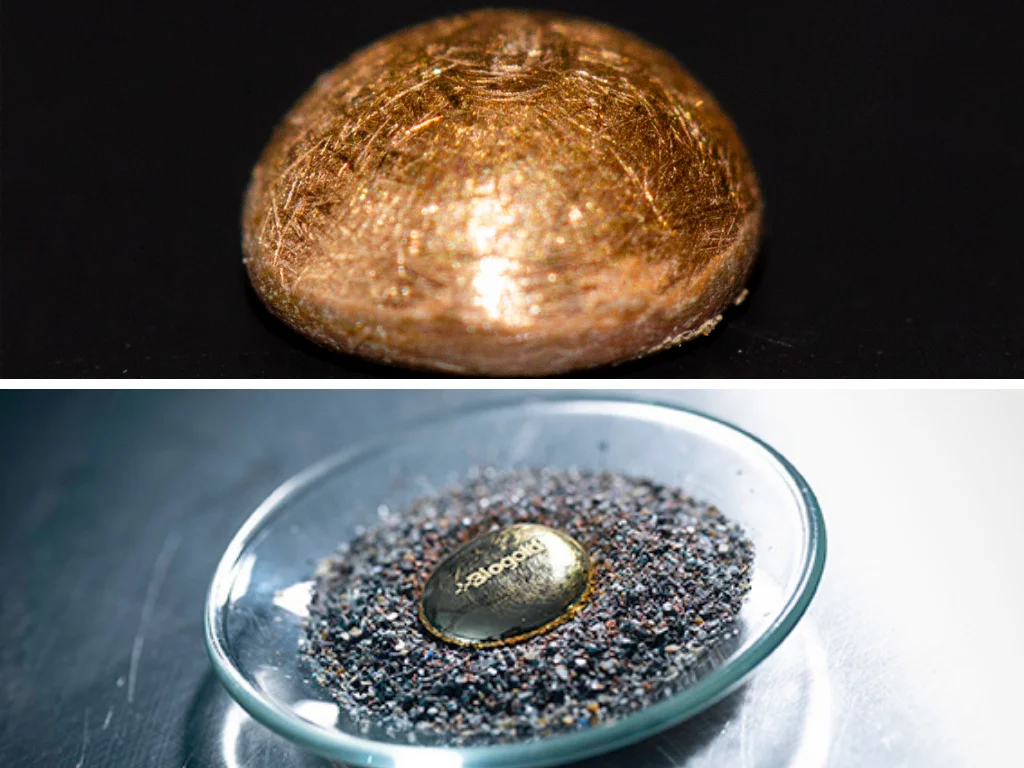
The final step is simple: the loaded sponge is burnt at over 1000 degrees Celsius. What remains are gold nuggets with 91 per cent purity - 22 carats. "Elemental gold rises like a phoenix from the ashes," enthuses Mezzenga. A 450-milligram nugget was created from 20 computer motherboards. Even with all the process costs, the added value is a factor of 50.
The vision continues: tests with mobile phones and microchip waste have been successful and scaling is underway. Mezzenga also hopes to use aerogels from other food waste to selectively bind other metals or even hormones. "Let's see what nature has in store for us."
The PX Group, a Swiss gold processor for the watch industry, is pursuing a different but equally innovative approach. in 2020, the company decided to develop its own ethical approach to gold, which should be extracted in the most environmentally friendly way possible, emphasises Andreas Blatter, Director of Research and Development.
The conventional process is problematic: electronic waste is incinerated, metals are left behind and gold is extracted. This consumes an enormous amount of energy, produces greenhouse gases and toxic substances and leaves behind mountains of hazardous waste. What's more, the scrap is often transported over long distances - which makes no sense economically or ecologically.
The PX Group, on the other hand, relies on a decentralised process that is used directly where electronic waste is generated. The process is elegant: after the plastic and metal have been separated, the metal is ground and placed in a tank. There, a biogenic substance - produced by bacteria from the partner Brain Biotech - dissolves the gold from the material. The bacteria ferment a sugar solution into a liquid that can dissolve gold, but is relatively pH-neutral and does not have to be disposed of as hazardous waste.
The solution is then filtered with a resin so that the gold adheres to the resin. This process allows the PX Group to bypass the strong acids and other highly toxic substances normally used in gold extraction, which damage the ecosystems around mines for years to come.
Alexandra Levesque, Head of Innovation and Development at the PX Group, emphasises that the process works and is technically feasible. The task now is to scale up the process and build up a network of partner companies so that the economic viability can also be proven. The potential is enormous: 20 to 30 tonnes of gold could be recovered from electronic waste worldwide every year. And the process could provide impetus for material cycles in many other industries.
These two showcases illustrate a fundamental change in the way we deal with resources. Waste is no longer just a disposal problem, but a valuable urban mine. Both approaches - the scientific one from ETH Zurich and the industrial one from the PX Group - show that environmentally friendly recycling not only makes ecological sense, but also economic sense.
What these innovations have in common: They replace environmentally harmful chemicals with bio-based solutions, function highly selectively and efficiently, and they close cycles. The whey method impresses with its selectivity and the elegant way in which it combines two waste streams. The bacterial process impresses with its decentralised nature and scalability for industrial applications.
At the same time, the examples show the strength of the Swiss innovation ecosystem: ETH Zurich delivers world-class basic research, while the PX Group translates innovation into industrial practice. Both projects demonstrate that Switzerland not only plays a pioneering role in the precision industry, but also in the sustainable circular economy.
The message is clear: the raw materials of the future do not lie deep underground, but in our drawers and recycling centres. With intelligent, bio-based processes, we can tap into these urban mines - for an economy that conserves resources instead of wasting them.
| Role | Title + Name |
|---|---|
| Text by | Esther Lombardini |